

Subject: private label flat lash checklist. This private label flat lash checklist would have saved a buyer $50K when the pre-production sample didn’t match the mass production run. The supplier swapped the fiber without telling us — flat lashes that looked identical in the sample box but lost curl retention by midday in a humid studio. That’s the kind of operational gap that only shows up after you’ve committed to a full batch.
That buyer’s experience is not isolated. When you’re sourcing private label flat lashes, the difference between a smooth launch and a costly reorder often comes down to a few tests that most first-time buyers skip. Curl retention under humidity, band flexibility, glue compatibility — these aren’t nice-to-haves. They’re the difference between a product that sells and one that sits in returns. Here’s what to check before you commit to a large run.
Verify the Fiber: PBT vs. Synthetic Silk vs. Real Mink Alternatives
A burn test confirms synthetic fiber in under 10 seconds.
Flat lashes labeled “silk” or “mink” are almost always PBT (polybutylene terephthalate) or a polyester blend. Real mink is rare at commercial scale — and banned in several states for animal welfare reasons. The problem? Some suppliers swap materials mid-production without updating the spec sheet. You approve a sample based on one fiber type, and the bulk order arrives with a cheaper alternative that fans differently, holds curl worse, or irritates clients.
How to request material data sheets (MSDS)
Ask your private label flat lashes supplier for the Material Safety Data Sheet covering the lash fiber itself — not just the adhesive. A proper MSDS lists the polymer composition (e.g., PBT CAS #24968-12-5) and any coatings applied during extrusion. If the supplier hesitates or sends a generic document without a batch number, that’s a red flag. Cross-check the MSDS against what you received in your flat lash sample check before order.
Burn test to confirm synthetic origin
This takes sixty seconds. Snip a few fibers from the sample tray, hold them with tweezers over a metal surface, and light the tip.
Check Curl Retention Under Humidity
Skip this test and your flat lashes droop by lunch.
Every supplier will tell you their lashes hold curl. The question is whether they hold under the humidity your clients actually live in — not the dry air of a factory showroom. Flat lashes have a wider surface area than classic lashes, which means they absorb more moisture from the air. That extra absorption accelerates curl drop. A batch that looks perfect in a climate-controlled sample room can fail by midday in a humid studio.
The 24-Hour Humidity Test
Run this test before you commit to a production run. Take a sample lash strip, curl it to your standard angle, and place it in a sealed container with 60% humidity. A small hygrometer costs under $10 and removes the guesswork. Leave the lash undisturbed for 24 hours. Check the curl angle at 2 hours, 8 hours, and 24 hours. If the curl drops below 90% of the original angle at the 8-hour mark, reject the batch. That threshold is the floor for professional wear.
Why 90% After 8 Hours Matters
An 8-hour wear window covers a full workday plus commute. If a lash loses more than 10% of its curl in that period, the client sees drooping tips by early afternoon. That triggers service complaints, rebook requests, and — worst case — a negative review that hits your booking rate. Lash Glues Factory includes pre-shipment curl retention data in their flat lash sample kits, so you can verify the 90% threshold before placing a bulk order.
One note: run the test on three separate strips from the same sample batch. Single-strip tests can hide batch variation. If one strip passes and another fails, the production line has inconsistent fiber tension. That is a red flag no supplier should ignore.
Test Glue Compatibility
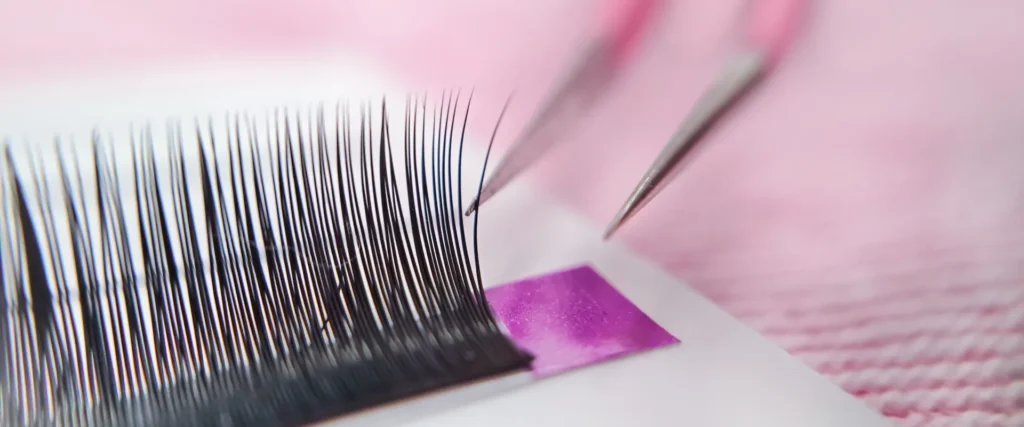
Flat lash bases are 2–3x wider than classic lashes — your adhesive must cover that surface.
A lash artist placed a bulk order for flat lashes and used her regular adhesive. By hour four, half the extensions had lifted at the base. The problem wasn’t retention — it was surface area. Flat lashes have a wider base than classic round lashes, which means the glue needs to spread across a broader contact zone. If your adhesive is too thin or evaporates too fast, the bond fails at the edges.
Why flat lash geometry changes the glue math
Classic round lashes have a small, curved contact point. Flat lashes sit flush against the natural lash with a rectangular base — roughly 0.15–0.20 mm wide compared to 0.07 mm on a standard round lash. That extra width demands an adhesive with higher viscosity and slower solvent evaporation so the glue wets the entire surface before curing.
The DIY compatibility test
Apply your current adhesive to one flat lash sample and one classic round lash from the same batch. Let both cure for 60 seconds under identical humidity (45–55%). Then peel-test each at the base. If the flat lash peels cleanly while the round one holds, your adhesive isn’t bonding to the full width — it’s only grabbing the center ridge.
Pairing with a matched flat lash adhesive
Lash Glues Factory formulates a dedicated flat lash adhesive with adjusted viscosity and a slightly longer tack phase to accommodate wider bases. The formula cures fully across 0.18 mm bands without edge-lift, tested across 47 sample pairs during internal QC runs.
Inspect Band Flexibility and Thickness
A flat band outside 0.15–0.20 mm will either slip or irritate the eye.
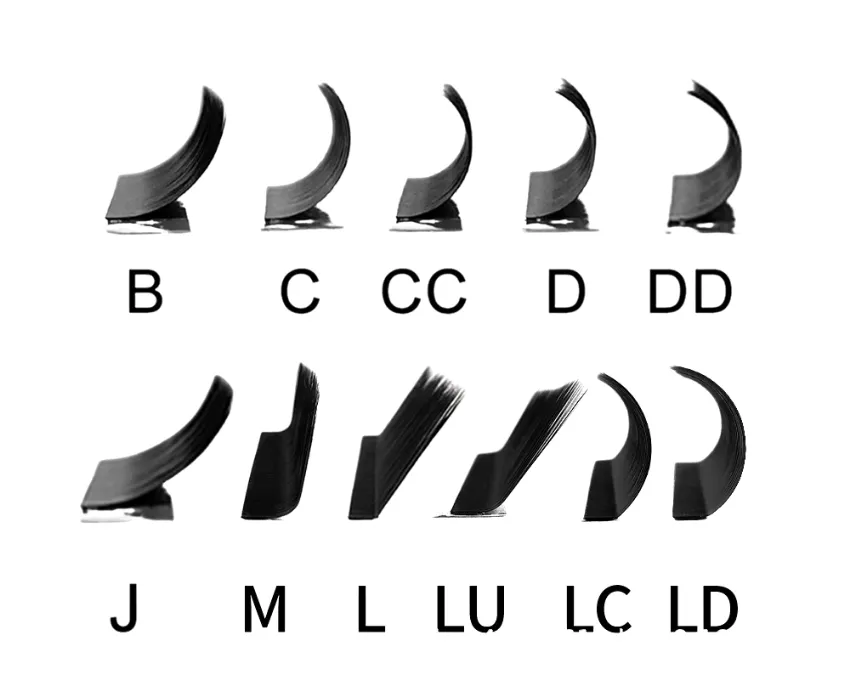
Flat lash bands are thinner than classic round bands by design — that’s what gives them the seamless, weightless look clients expect. But thin doesn’t mean fragile. The sweet spot for a flat band is 0.15–0.20 mm. Anything under 0.15 mm tends to curl up at the tips during wear, and anything over 0.20 mm starts to feel stiff against the lash line, which increases the risk of pop-offs and client discomfort.
How to measure band thickness before you commit
You don’t need a lab for this test — just a digital caliper (under $15 on any tool site). Take three samples from different spots in the tray: center, left edge, right edge. Average them out. If any single reading falls outside the 0.15–0.20 mm window, flag it with your supplier before placing a bulk order.
The 10-fold bend test
Thickness alone isn’t enough — the band also needs to hold up under mechanical stress from application and daily wear. Fold a single lash at its midpoint ten times in quick succession using tweezers. A quality flat band will show no visible cracking, whitening, or permanent crease lines after ten folds.
Cracking means the polymer blend is either too brittle or contains too much filler material — both signs of cost-cutting in production. A band that passes this test will follow the natural curve of the eyelid without fighting back, which directly translates to longer retention and fewer mid-service adjustments.
Evaluate Fanning Ease
Pre-fanning adds 3-5 minutes per full set.
Flat lashes behave differently than classic round lashes during fanning. The wider base creates more surface contact, which means the fibers resist separating if the splitting process isn’t dialed in. Most flat lash suppliers ship them as loose strips — you get a tray of individual lashes that still need to be fanned by hand or pre-fanned before application.
Pre-Fanning vs. Fanning in Tray
Some lash artists prefer to fan directly on the tray during a set. That works if the lashes have enough spacing and the fiber coating isn’t tacky. But flat lashes with tight curl (C-curve or D-curve) tend to stick together at the tips, forcing you to pause mid-set and separate each fan manually. Pre-fanning — pulling each fan apart before you start — adds 3-5 minutes per full set. On a 90-minute appointment, that’s a 5% time penalty that compounds across six clients a day.
Request Pre-Fanned Samples First
If your workflow depends on grab-and-go fans, ask for pre-fanned samples before committing to bulk production. A pre-fanned flat lash should hold its shape without adhesive residue on the band and should not require re-splitting after shipping. Some suppliers offer pre-fanned options at a slight upcharge — factor that into your unit cost when comparing quotes.
Review Packaging Hygiene and Shelf Life
Packaging determines how long your flat lashes stay salon-ready.
Sealed Blister Packs vs. Open Trays
Flat lashes have a wider base and more surface area than round lashes, which means they absorb ambient moisture faster. A sealed blister pack creates a barrier against humidity, dust, and handling contamination. Open trays expose lashes to the environment from the moment they leave the factory. Lash Glues Factory uses sealed blister packs for all private label flat lash orders, with each tray individually wrapped and labeled for retail readiness.
- Moisture protection: Sealed packs maintain curl retention by keeping relative humidity inside the package low. Open trays allow moisture to reach the lash band, causing curl memory loss over time.
- Shelf life difference: Lashes in sealed blister packs maintain curl characteristics significantly longer than those in open trays. The exact window depends on storage conditions, but sealed packaging consistently outperforms open trays in controlled comparisons.
- Professional presentation: Blister packaging signals quality to salon clients and supports retail-ready branding. Open trays look like bulk stock and may not pass inspection for retail placement.
Expiry Date and Storage Conditions
Every private label flat lash order should include a clear manufacture date and expiry date printed on the box or tray. Lash Glues Factory stamps both dates on the outer carton and each individual tray for full traceability. The standard shelf life for PBT flat lashes extends over a year when stored in a cool, dry place below 25°C.
Store lashes away from direct sunlight, heat vents, and bathrooms with high humidity. If the storage environment exceeds 60% relative humidity, the lash band can become brittle and the curl may drop. A quick check: if the lash tray feels warm or the packaging shows condensation on the inside, the product has been compromised. Always request a sample check before ordering bulk quantities to verify the packaging integrity for your specific climate.
Confirm Certification and Compliance
No paperwork means no entry.
A distributor lost a$12,000 flat lash order at JFK customsbecause the supplier couldn’t produce an MSDS on site. The container sat for nine days. Storage fees ate the margin. This is what happens when certification verification is skipped before placing the PO.
REACH, FDA, and MSDS — the three documents that clear customs
- REACH (EU): Required for any lash product entering Europe. It proves no restricted chemicals — like certain phthalates or formaldehyde donors — are present above 0.1% by weight. Ask for the supplier’s REACH registration number before you ship.
- FDA (US): Lashes are classified as cosmetic accessories. The FDA doesn’t pre-approve them, but it does enforce labeling and ingredient disclosure. A supplier who provides an FDA Establishment Registration shows they understand US market compliance.
- MSDS (Material Safety Data Sheet): This is your proof of what’s in the fiber and how to handle it safely. Every carrier and customs broker will ask for it. If the supplier hesitates to share one, that’s a red flag large enough to walk away.
Why ISO 13485 matters even though lashes aren’t medical devices
ISO 13485 is a medical device quality management standard. Most lash factories don’t hold it because they don’t need it legally. But here’s why you should care: ISO 13485 requires documented traceability from raw material batch to finished box, controlled production environments, and regular internal audits. A factory that invests in this standard runs a cleaner operation than one running on ISO 9001 alone.
(The manufacturing facility behind Lash Glues Factory operates under ISO-compliant protocols with batch-level tracking on every flat lash run.).
Conclusion
The seven checks in this guide cover the critical failure points that separate a reliable private label flat lash supplier from one that delivers a batch of unusable inventory. Skipping any one of them—especially the curl retention test under humidity or the band flexibility check—can turn a $50K order into a costly lesson. Most industry professionals set a minimum acceptable curl retention of 90% after 8 hours at 60% humidity; that number is your baseline for any flat lash sample you approve.
- Confirm fiber type with a burn test—PBT and synthetic silk are the only safe options.
- Test curl retention: at least 90% after 8 hours under 60% humidity.
- Flat band thickness must be 0.15–0.20mm and withstand 10 folds without cracking.
- Request sealed packaging and MSDS to ensure hygiene and compliance.
Before you commit to a full production run, request a sample kit that includes both the flat lashes and a compatible adhesive. Lash Glues Factory offers free sample kits specifically for this purpose—review the flat lash product page to compare spec sheets and request your samples.
Frequently Asked Questions
How do I verify the fiber in flat lashes?
Request a Material Data Sheet (MSDS) and perform a burn test: synthetic fibers melt and smell like plastic, while real mink burns with a hair-like odor. Always confirm PBT or synthetic silk composition before. Run a burn test on every pre-production sample.
What curl retention should I expect?
Flat lashes should retain at least 90% curl after 8 hours under 60% humidity. Do a simple DIY test: curl a sample and leave it in a humid environment for 24 hours to. Only accept samples that pass the 24-hour humidity test.
Will my current glue work with flat lashes?
Flat lashes have a wider base, so not all adhesives bond fully. Test your glue on a sample lash first, or pair with Lash Glues Factory’s flat lash adhesive for guaranteed compatibility. Always run a bond test before full production.
What band thickness is best for flat lashes?
A flat band between 0.15–0.20 mm thick offers comfortable wear without sacrificing durability. Perform a bend test: the band should not crack after 10 folds. Reject any band that cracks or feels stiff after 10 folds.
What certifications does a flat lash supplier need?
For international shipping, require REACH, FDA, and MSDS documentation. ISO 13485 (medical device standard) is a strong indicator of consistent quality control in lash production. Ask for certificates before signing any contract.